SINDHURA INNOVATIONS
STEM EDUCATION
Learn by Building, Exploring & Creating
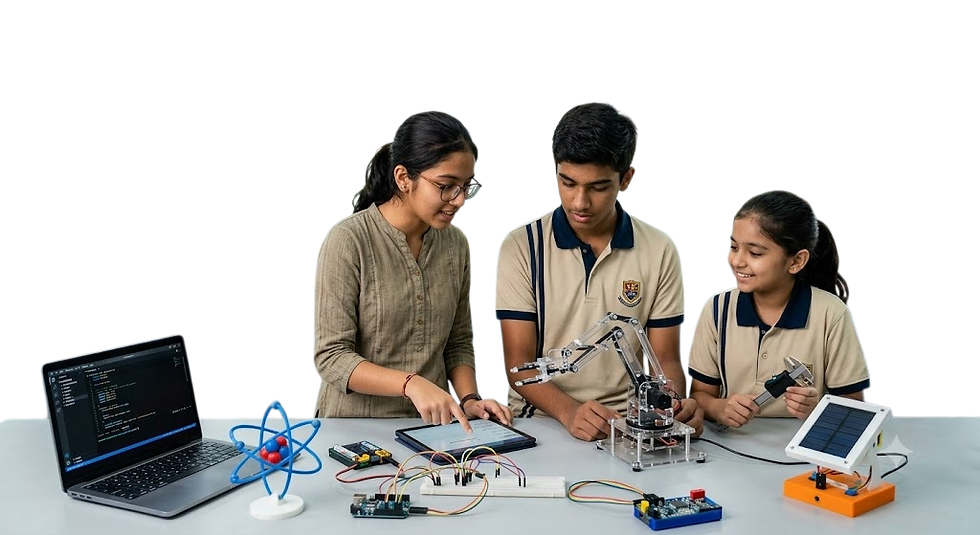
We make Science, Technology, Engineering and Mathematics easier to understand through hands-on learning, projects and experiments.
What is STEM?
STEM stands for Science, Technology, Engineering and Mathematics. It brings these four areas together to help students understand ideas, solve problems and create useful things.
SCIENCE
Learn how the world around us works.
TECHNOLOGY
Use tools and technology to solve problems.
ENGINEERING
Design, build and improve solutions.
MATHEMATICS
Use numbers, logic and patterns to understand and solve problems.
STEM is not just about learning subjects.
It is about learning how to think, create and solve problems.
01
ASK
Understand the problem.
How STEM Learning Works
Students learn by exploring ideas, trying things, solving problems and improving their work.
02
EXPLORE
Find out how things work.
03
BUILD
Create an idea or solution.
04
TEST
Try it and see what happens.
05
IMPROVE
Learn from the result and make it better.
What Students Learn
STEM learning helps students develop practical skills they can use in school, work and everyday life.
PROBLEM SOLVING
Learn to understand problems and find practical solutions.
CREATIVE THINKING
Turn ideas into new projects and solutions.
LOGICAL THINKING
Learn to think clearly, understand patterns and make decisions.
PRACTICAL SKILLS
Learn by building, experimenting and working with real tools.
TEAMWORK
Work with others, share ideas and solve challenges together.
CONFIDENCE
Build the confidence to try, test, make mistakes and try again.
What We Offer
We provide practical STEM learning experiences that help students learn by doing.
STEM WORKSHOPS
Hands-on sessions where students explore concepts through activities and experiments.
STEM KITS
Ready-to-use learning kits that let students build, test and experiment at their own pace.
SCHOOL PROGRAMS
Structured STEM activities designed for schools, classrooms and student groups.
PROJECT-BASED LEARNING
Students learn by working on real projects from idea to working result.
INNOVATION ACTIVITIES
Creative challenges that encourage students to think, design and build their own solutions.
Who Can Benefit from STEM Learning?
STEM learning can be designed for:
Students
Learn through age-appropriate activities and projects.
Schools
Bring practical STEM learning into classrooms and school programs.
Teachers
Use hands-on activities to make concepts easier to understand.
Create structured STEM learning and innovation programs.